Your makeup trial goes perfectly in May. Your wedding is in December, and by the pheras your base looks tight and patchy. That is not bad luck. Skin changes with the season, and bridal makeup has to change with it.
This guide explains the main types of bridal makeup and shows which one suits your skin type and wedding month. Start with the chart below, then read the parts that match you.
Short answer: The best bridal makeup depends on your skin type and wedding month. Oily skin suits matte or satin long-wear makeup, especially for May–June weddings. Dry skin suits cream, hydrating bases, especially in winter. Combination skin needs different primers by zone. Sensitive skin needs patch-tested, fragrance-free products. HD suits most skin in photos. Airbrush suits smooth, oily-to-normal skin.
Quick-pick chart
| Skin type | Best finish | Best system | Avoid | Months to plan for |
| Oily | Matte or satin | Airbrush or light HD | Dewy finish, heavy creams | May–Sep |
| Dry | Satin, hydrated glow | Traditional cream or HD | Matte long-wear, heavy powder | Nov–Feb |
| Combination | Satin, matte T-zone | HD or traditional | One product all over | Mar–Apr, Oct |
| Normal | Natural satin | HD, airbrush or traditional | Over-layering | Any |
| Sensitive | Mineral or fragrance-free | Patch-tested HD or traditional | New products late | Winter, peak summer |
| Acne-prone | Light matte-satin | Thin HD or airbrush | Heavy coverage, unclean tools | Monsoon |
| Mature | Soft, creamy satin | Traditional or light HD | Glitter on lines, heavy powder | Winter |
How do I know my skin type before choosing bridal makeup?
Wash your face with a gentle cleanser, pat dry and wait 30 minutes without applying anything. If your forehead, nose and chin shine, your skin is oily or combination. If it feels tight, it is dry. If neither happens, it is normal.
Skin type vs skin condition
Acne, sensitivity, dullness and pigmentation are conditions. They sit on top of your skin type, so tell your artist about both.
Why your skin type can change with the season
Many brides are oilier in summer and drier in winter. That is why a May trial can mislead you for a December wedding.
Which bridal makeup is best for each skin type?
Choose by how your skin behaves, not by trend. Oily skin needs oil control. Dry skin needs hydration and cream textures. Combination skin needs different products by zone. Sensitive and acne-prone skin need gentle, tested products. Mature skin looks best with thin, creamy layers.
Bridal makeup for oily skin
Use a mattifying primer on the T-zone, a thin oil-free base and a light setting powder. Airbrush or lightweight HD works well. Skip dewy highlighter on shiny areas. Keep skincare light and avoid heavy creams in the final week.
Bridal makeup for dry skin
Ask for a hydrating primer, a cream or satin base and powder only where makeup creases. Avoid matte long-wear formulas. Moisturise morning and night for several weeks, and exfoliate gently so flakes don’t show.
Bridal makeup for combination skin
Use two primers: mattifying on the T-zone and hydrating on the cheeks. One satin base is usually enough. Set only the T-zone with powder.
Bridal makeup for normal skin
You have the most choice. Pick the finish that suits your look, then check it under flash at your trial.
Bridal makeup for sensitive skin
Choose fragrance-free products and patch test everything, including lash glue, at least a week before. Use the same products on the wedding day. Add no new skincare in the last two weeks.
Bridal makeup for acne-prone skin
Ask for non-comedogenic, oil-free products, thin layers and clean tools. Use colour correction on spots instead of heavy coverage. Discuss treatments with your dermatologist, not your makeup artist.
Bridal makeup for mature, textured or pigmented skin
Hydrate first, then use a thin satin base and cream blush. Avoid glitter on fine lines and heavy powder. For texture, press product in rather than sweeping it across. Choose your shade by undertone (warm, cool or neutral) in daylight.
What are the main types of bridal makeup?
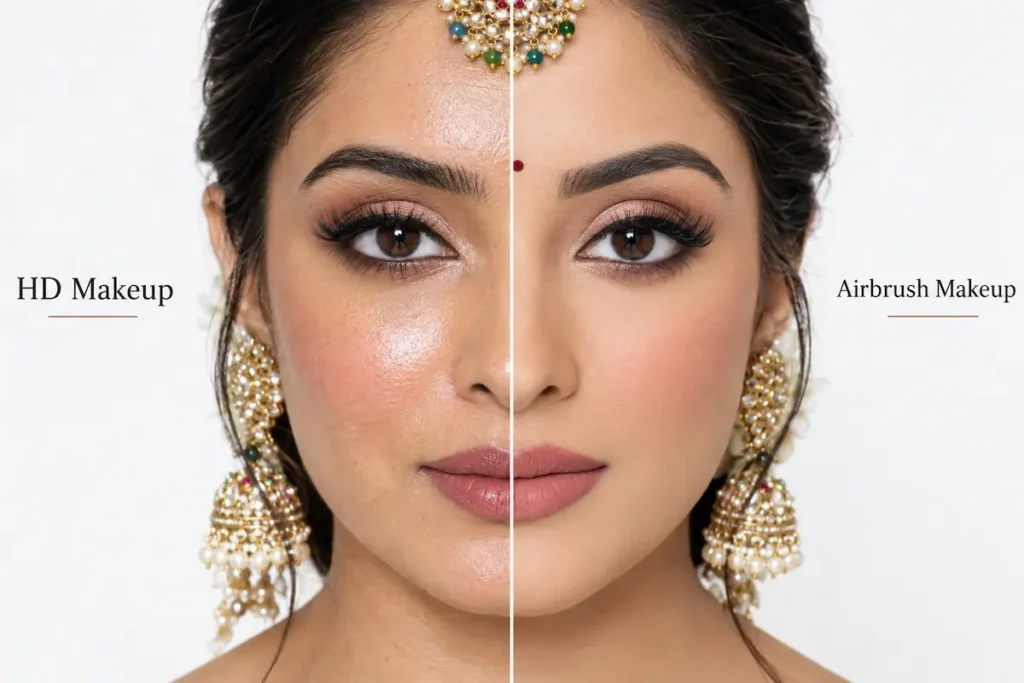
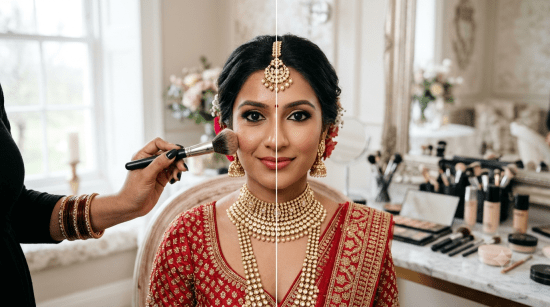
The main types of bridal makeup are HD, airbrush, traditional, matte, natural and mineral. Some describe how makeup is applied (airbrush, traditional). Others describe the finish or ingredients (matte, natural, mineral). Artists often mix them, such as an HD base with a matte T-zone.
| Type | How it works | Best for | Watch out |
| HD | Light, smooth layers that look even in photos | Most skin, heavy photography | Too much powder can look cakey |
| Airbrush | Fine mist sprayed on in a very thin layer | Smooth, oily to normal skin, long events | Needs hydrated skin; often costs more |
| Traditional | Brushes and sponges with cream or liquid bases | Dry, mature, textured skin | Result depends on the artist’s blending |
| Matte | Oil-controlling, shine-free finish | Oily, combination | Can look flat on dry skin |
| Natural | Sheer base, soft colour | Daytime or minimal looks | Needs good skin prep |
| Mineral | Mineral-based formulas | Sensitive skin | Shade range varies by brand |
What is the difference between HD and airbrush makeup? HD is applied with brushes and sponges. Airbrush is sprayed on with a tool, which gives a thinner layer. Our HD vs airbrush makeup guide compares them in detail.
Flash photography can make some sunscreens and powders look pale. Always take a flash photo at your trial.
Which bridal makeup is best for your wedding month?
Match the formula to the weather, not just your skin. Hot months need oil control. Humid months need a light base and a strong set. Winter needs hydration and cream textures. Spring and early autumn sit in between.
Many Hindu wedding dates fall between November and February and between April and June, with a pause in mid-year. Dates differ by calendar and community, so check with your family pandit or Drik Panchang.
Winter weddings (Nov–Feb)
Dry air causes flaky patches. Hydrate for weeks and choose cream blush and a soft glow.
Spring and pre-summer weddings (Mar–Apr)
Heat is rising and oil shows up early. Switch to lighter bases and a mattifying primer on the T-zone.
Peak summer weddings (May–Jun)
Sweat and melting are the risks. Choose airbrush or light HD, waterproof eye products and a strong setting spray. Carry blotting paper.
Monsoon and post-monsoon weddings (Jul–Oct)
Humidity makes makeup slide. Use a thin base, waterproof eyes and a sealing spray.
Day vs night, indoor vs outdoor
Daylight shows texture. Evening flash shows shine. Ask your artist to check your look in both.
Skin type × wedding month: your quick-match chart
Find your skin type on the left and your wedding season across the top. Each cell shows what to ask your artist for. Use it to start the conversation, then confirm at your trial.
| Skin type | Winter (Nov–Feb) | Spring (Mar–Apr) | Summer (May–Jun) | Monsoon (Jul–Oct) |
| Oily | Satin base, light powder | Matte T-zone, thin base | Airbrush or light HD, strong set | Thin base, waterproof eyes |
| Dry | Hydrating cream base | Satin base | Light hydrating base | Satin, little powder |
| Combination | Satin, extra cheek hydration | Two primers | Matte T-zone, satin cheeks | Light HD, sealing spray |
| Sensitive | Fragrance-free, barrier-friendly | Patch-tested mineral or HD | Light, breathable layers | Fragrance-free, waterproof tested |
| Mature | Cream, minimal powder | Thin satin | Light satin, set T-zone | Thin base, no shimmer on lines |
What should I do before the big day?
Start skin prep about three months out and stop trying new products two weeks before. Keep your routine simple, hydrate well and book your trial early. If your skin is acne-prone or sensitive, see a dermatologist first.
- 3 months: Use a gentle cleanser, moisturiser and daily sunscreen.
- 6 weeks: Do your trial. Oily skin: focus on oil control. Dry skin: build a hydrating routine.
- 2 weeks: No new products, facials or treatments.
- 1 week: Gentle exfoliation only. Drink water and sleep well.
- Day before: Light moisturiser and nothing new.
How do I choose a makeup artist and run a useful trial?
Choose an artist who asks about your skin, not just your outfit. Book a trial 4–6 weeks before the wedding, ideally in a similar season. Wear the makeup for a few hours and take photos with flash.
Tell your artist: how your skin behaves through the day, any allergies, the products you use, and your wedding month and venue.
Ask: Which formula are you using and why for my skin? Which system suits me: HD, airbrush or traditional? How will you set it?
Looking for an expert? Explore bridal makeup options or find a bridal makeup artist in Delhi.
Bridal makeup mistakes to avoid
- Trying new products in the final two weeks
- Judging your shade only at the trial. Check again after a few hours, because oily skin can turn warmer.
- Ignoring heat and humidity at the venue
- Using heavy powder on dry skin
- Skipping sunscreen in your prep (test it under flash)
- Having no touch-up kit
Frequently asked questions
Which type of bridal makeup is best?
There is no single best type. HD suits most skin and looks good in photos. Airbrush suits smooth, oily to normal skin. Cream-based traditional makeup often suits dry or mature skin. Choose by skin type and wedding month, then confirm at a trial.
Is airbrush or HD better for oily skin?
Both can work. Airbrush gives a very thin, long-lasting layer, so many oily-skin brides prefer it in summer. A well-prepped HD base with a matte T-zone also holds well. Your trial shows which lasts longer on you.
What makeup suits a winter bride with dry skin?
Ask for a hydrating primer, a cream or satin base and cream blush. Use powder only where makeup creases. Avoid matte long-wear formulas, and moisturise well for several weeks before the wedding.
How long does bridal makeup last?
Professional bridal makeup is usually built to last through the main events, often 8–12 hours. Skin type, weather, prep and touch-ups all matter, so ask your artist what to expect for your wedding month.
When should I do my bridal makeup trial?
Book it 4–6 weeks before the wedding, in a similar season if possible. Bring photos of your outfit and jewellery, and take pictures in daylight and with flash.